
The Lobster Revolution
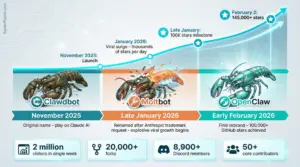
I’ve been tracking AI developments for years, but nothing prepared me for what happened in January 2026. Within weeks, an open-source AI agent called OpenClaw (previously Clawdbot, then Moltbot) exploded from obscurity to 100,000+ GitHub stars.

The Capital Efficiency Paradox
The conventional narrative says frontier technology requires massive capital. These women are proving the opposite: capital efficiency isn’t about doing less with less—it’s about achieving breakthrough outcomes through architecture that compounds rather than burns resources.

The Brain-Inspired Revolution
Intel Loihi 3 and IBM NorthPole achieve 1,000x GPU efficiency. The neuromorphic revolution just ended NVIDIA’s edge AI monopoly—and the strategic implications cascade across robotics, autonomous vehicles, and distributed intelligence deployment.

Research Methodology and Source Verification for the Capital Efficiency Paradox Series
At Sapien Fusion, credibility isn’t negotiable. Every claim in the Capital Efficiency Paradox series underwent systematic verification before publication. This document provides full transparency into our research methodology, source hierarchy, and verification protocols.

Part 4 – $230M to $1B in Four Months
Most AI labs pursued incremental improvements on text and 2D image generation. Fei-Fei Li recognized something different during her 2017-2018 tenure as VP and Chief Scientist of AI/ML at Google Cloud: AI systems operated in a fundamentally two-dimensional paradigm, processing text tokens and image pixels without genuine spatial understanding.

Part 5 – From 20 Researchers to 2.7 Billion Downloads
In 2017, Joelle Pineau joined Meta to establish FAIR’s Montreal laboratory with 20-30 researchers. By 2025, when she left to become Chief AI Officer at Cohere, that research organization had released over 1,000 research artifacts—code, models, datasets—downloaded 2.7 billion times globally.

Part 6: The Software Problem
This is Part 6 of our 6-part Deep Dive series on neuromorphic computing—the brain-inspired processors achieving 1,000× efficiency improvements over GPUs at the edge. ←

Part 5: The Automotive Bet
This is Part 5 of our 6-part Deep Dive series on neuromorphic computing—the brain-inspired processors achieving 1,000× efficiency improvements over GPUs at the edge. ←

Part 4: The ANYmal Proof
This is Part 4 of our 6-part Deep Dive series on neuromorphic computing—the brain-inspired processors achieving 1,000× efficiency improvements over GPUs at the edge. ←

Part 3: IBM NorthPole
This is Part 3 of our 6-part Deep Dive series on neuromorphic computing—the brain-inspired processors achieving 1,000× efficiency improvements over GPUs at the edge. ←
Part 2: The 1,000x Efficiency Breakthrough
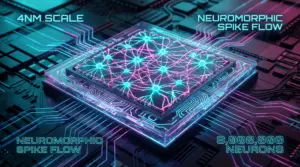
This is Part 2 of our 6-part Deep Dive series on neuromorphic computing—the brain-inspired processors achieving 1,000× efficiency improvements over GPUs at the edge. ←

Part 1: The Three Walls
This is Part 1 of our 6-part Deep Dive series on neuromorphic computing—the brain-inspired processors achieving 1,000× efficiency improvements over GPUs at the edge. Index
The Brain-Inspired Revolution
Intel Loihi 3 and IBM NorthPole achieve 1,000x GPU efficiency. The neuromorphic revolution just ended NVIDIA’s edge AI monopoly—and the strategic implications cascade across robotics, autonomous vehicles, and distributed intelligence deployment.
The Lobster Revolution
I’ve been tracking AI developments for years, but nothing prepared me for what happened in January 2026. Within weeks, an open-source AI agent called OpenClaw (previously Clawdbot, then Moltbot) exploded from obscurity to 100,000+ GitHub stars.
The Capital Efficiency Paradox
The conventional narrative says frontier technology requires massive capital. These women are proving the opposite: capital efficiency isn’t about doing less with less—it’s about achieving breakthrough outcomes through architecture that compounds rather than burns resources.

Part 3 – $800M to Rebuild Drug Discovery
Daphne Koller’s insitro reduces drug development from 10-15 years to 3-6 years through ML-first architecture—computational prediction replacing 80% of wet lab experiments, achieving 80-90% Phase I success rates.

Part 2- Building the First Longitudinal Women’s Health Dataset
Dr. Ariella Heffernan-Marks built dual infrastructure enabling 48-hour vaccine manufacturing—how Ovum’s consumer product and research platform create bidirectional value addressing the $1 trillion gender health gap.

Part 1 – Capital Efficiency Through Humanoid Telepresence
Alona Kharchenko achieved real-world humanoid robot deployment with €720K in grants while billion-dollar competitors remain years away—through hybrid intelligence architecture and strategic positioning in Germany’s care crisis.
Part 6 – Capital Efficiency Through Government-to-Commercial Path
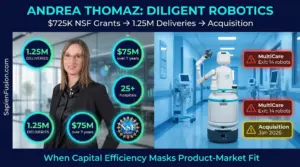
Twenty years. One technical obsession. By March 2025, Andrea Thomaz’s Diligent Robotics had deployed robots that completed one million deliveries across dozens of hospitals—navigating elevator crowds, dodging stretchers in narrow corridors, and handing medication to nurses who were “so thankful” they posed for selfies with the machines.

Part 7 – The Capital Efficiency Playbook
This final installment synthesizes actionable frameworks, decision points, and strategic implications for operators, investors, and policymakers working in capital-intensive frontier technology domains.

3 – Seven Companies are Racing to be First
The first FDA approval for a CAR-T therapy in autoimmune disease is expected in the first half of 2026. The regulatory approvals that follow will determine which companies actually reach the 17.9 million RA patients.

2 – What is a Cure Worth?
Every health economist has run the same calculation: cost of drug A versus cost of drug B, measured in quality-adjusted life years, assessed over a 10-year horizon. That model is built for a world where nothing cures the disease.