
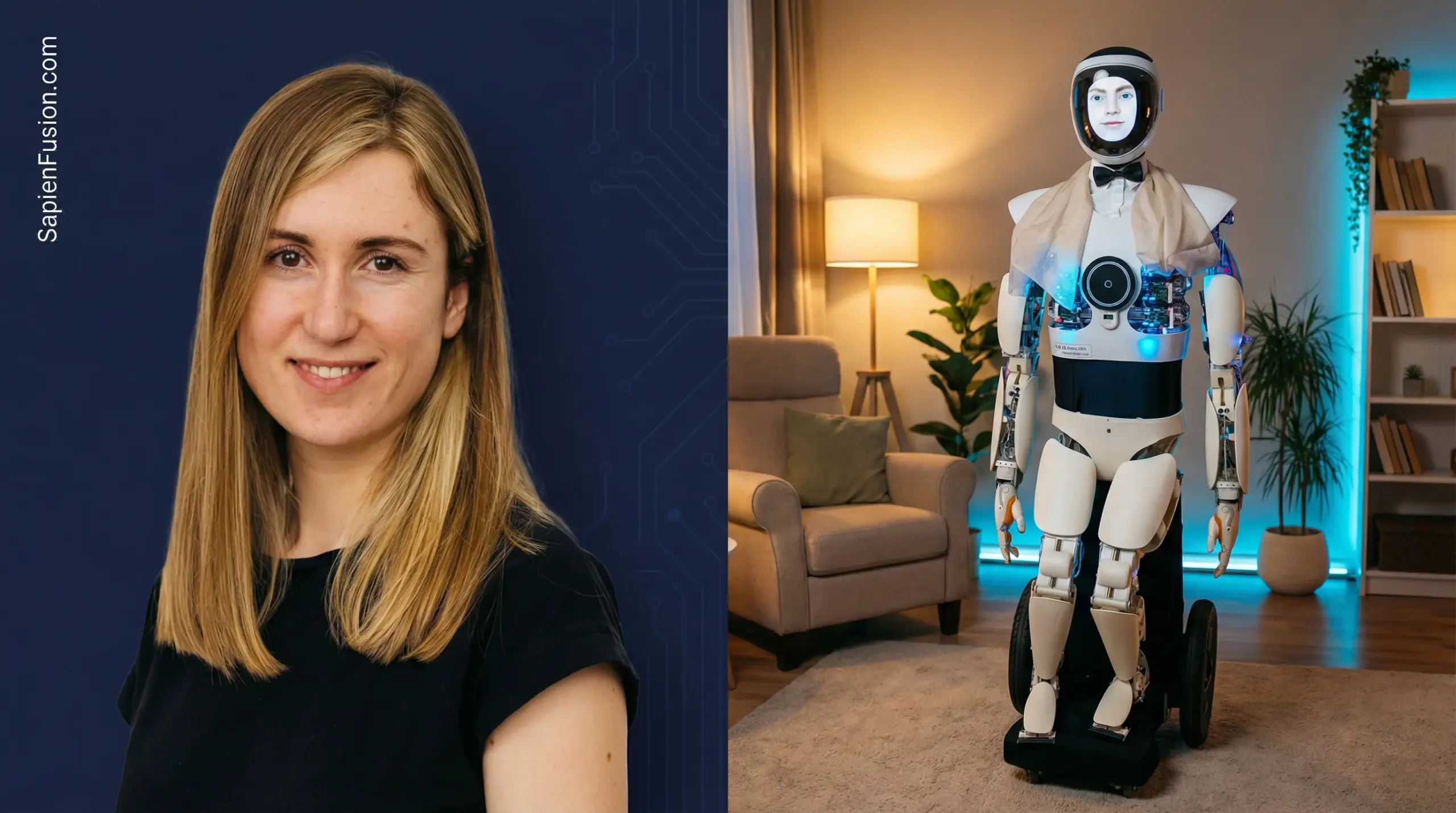
This is Part 1 of 7 from The Capital Efficiency Paradox Series.
← The Capital Efficiency Paradox | Part 2: Building the First Longitudinal Womens Health Dataset →[🧠] Sapien Fusion Deep Dive | February 16, 2026
Alona Kharchenko’s €720K to Real-World Deployment
Three people. €720,000 in government grants. Zero venture capital. By March 2024, Alona Kharchenko‘s Devanthro had achieved what billion-dollar autonomous robotics companies haven’t: a humanoid robot living in an 89-year-old woman’s home for three consecutive days, navigating narrow corridors, hanging laundry together, and doing it safely.
Most humanoid robotics companies are burning through hundreds of millions chasing full autonomy that remains “years away—for everyone.” Kharchenko chose a different path.
The Bleeding Edge Decision
When Kharchenko arrived in Germany from Ukraine in 2014 on a DAAD scholarship to pursue her Master’s in Robotics, Cognition, and Intelligence at TUM, she had a clear trajectory: doctorate, academic research, maybe a professorship. Then she met Rafael Hostettler, a PhD student whose vision was to “build robots as good as the human body.”
That encounter redirected everything. “From the outset, I recognized the significant potential of this technology to positively impact society,” Kharchenko reflects. “I was driven by the desire to bring it into millions of homes. Launching a venture was the key to making this vision a reality.”
In 2018, at age 27, she co-founded Devanthro as CTO. The company took an “unusual approach in robotics” by “bringing our robots out of the lab very early on,” leading to “tens of thousands of interactions of our robots with the general public in the real world.”
While competitors pursued laboratory perfection, Kharchenko was learning from real humans touching real robots. You can see those interactions on Devanthro’s YouTube channel.
The Hybrid Intelligence Thesis
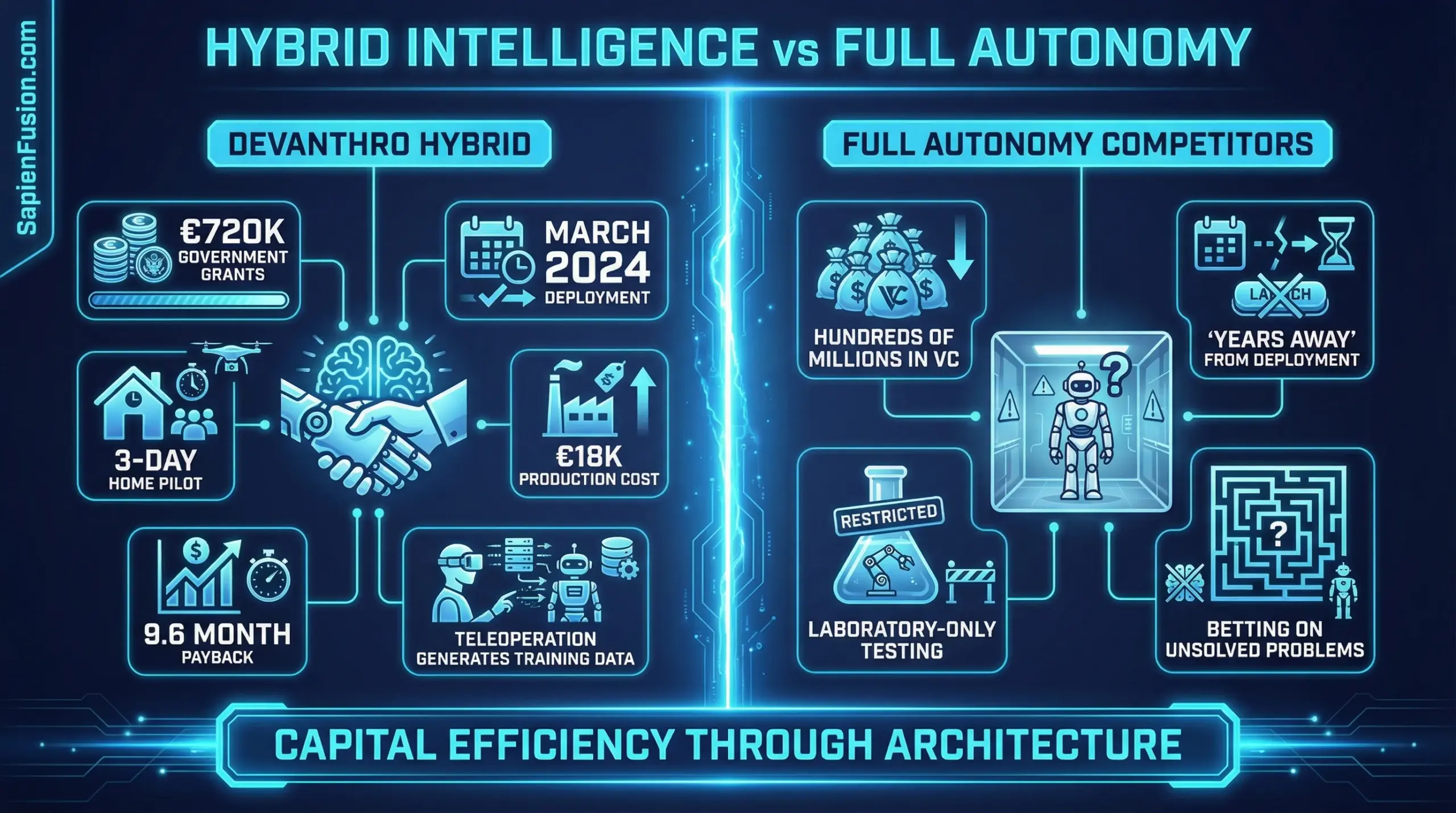
Here’s where Devanthro’s capital efficiency advantage crystallizes. The company explicitly rejects the autonomous robotics playbook. “Full autonomy in unstructured home environments is years away—for everyone,” their technical documentation states bluntly. “The manipulation, reasoning, and safety requirements are unsolved problems.”
Instead of burning capital trying to solve unsolved problems, Devanthro built what they call “hybrid intelligence”—human teleoperation via VR headsets for complex tasks requiring empathy and judgment, with AI handling routine, repetitive actions.
Every teleoperation session generates training data. More deployments mean better autonomy, which enables more deployments. It’s a compounding advantage that doesn’t require betting on scientific breakthroughs.
The capital efficiency numbers tell the story:
Robody unit economics:
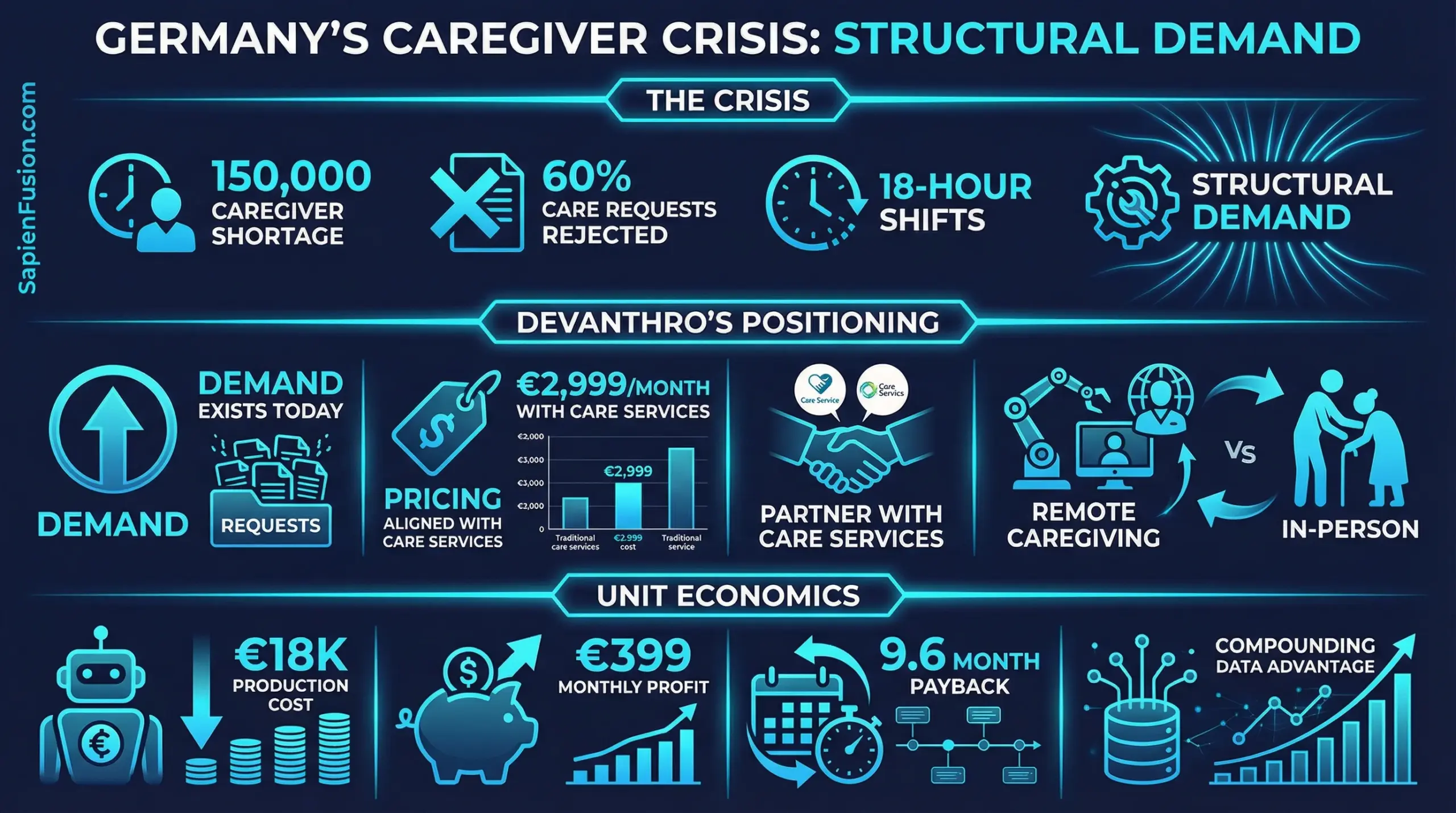
- Production cost: €18,000 per unit
- Monthly profit for care services: €399
- Payback period: 9.6 months
- Monthly cost for families: €2,999 (competitive with live-in caregivers)
By 2023, with just €720,000 in equity-free BMBF grants and €46,000 in revenue, Devanthro was actively deploying robots in real homes.
The Three-Day Validation
March 2024. Pirmasens, Germany. Ms. Smith, 89 years old. Three days living with Robody.
The robot “navigated narrow corridors of the flat, drove over rugs often layered on top of each other and manipulated objects of daily use.” It facilitated “physical and cognitive activation exercises, planning and maintaining day structure, bringing water and reminding to drink, accompanying during lunch and even hanging up laundry together.”
Hanging laundry. With an elderly person. In an unknown home environment. That’s the kind of nuanced, collaborative task that autonomous systems find profoundly challenging due to textile unpredictability, material deformation, and the need for real-time adaptive responses.
The care staff at Diakoniezentrum Pirmasens provided “overwhelmingly positive feedback” and expressed “readiness to host the next longer pilot.”
By comparison, Boston Dynamics—despite exceptional public visibility and massive capital—”has built and sold less than 1000 robots” across its entire lifetime.
The February 2022 Crucible
Capital efficiency isn’t just about money. It’s about what you accomplish when resources are constrained.
February 24, 2022. Russia invades Ukraine. Devanthro is bringing Robody to a care residence to show elderly residents for the first time. Simultaneously, Kharchenko is “planning the escape of my sister out from Ukraine away from Russian bombings.”
At this moment, Devanthro is three people approaching investors for their first significant fundraise. They have a robot sold to Oxford University that needs finishing.
For two months, Kharchenko “spent volunteering pretty much full-time, coming in only late night to the office to finish the robot we just sold to the Oxford University, while having at home two 20-year Ukrainian girls who could not function in Germany without me.”
She describes wrestling “with guilt and moral dilemmas about how to use my time” between “caring for family vs helping people suffering in Ukraine vs building my company.”
The robot got finished. Oxford got their Robody. The company survived.
That’s capital efficiency as resilience: accomplishing objectives despite catastrophic personal circumstances and minimal team bandwidth.
Strategic Positioning: The Care Crisis Multiplier
Germany lacks 150,000 caregivers. When care services reject 60% of requested work because staff are already burning out working 18-hour shifts, there’s no market risk. Demand is structural, acute, and growing.
Devanthro doesn’t need to create aspirational demand or educate markets. They need to execute on proven demand with technology that works today.
The company’s “Innovate Just Enough” framework explicitly acknowledges this: change “just one thing from an existing offering”—enable live-in caregivers to work remotely rather than requiring physical presence. Maintain pricing aligned with existing care service models. Collaborate with established care services rather than disrupting them.
This is capital-efficient positioning: solve the immediate, urgent problem that customers will pay for today, while accumulating data that enables solving harder problems tomorrow.
The Recognition Pattern
Forbes 30 Under 30. Women TechEU grant (40 selected from 800+ applications). Permanent exhibition at Deutsches Museum. Partnerships with Charité Berlin, Oxford University, Diakonie.
These aren’t vanity metrics. They’re validation that Devanthro’s approach—human-operated robots for immediate deployment while building toward autonomy—represents genuine innovation rather than incrementalism.
When asked about obstacles as a female founder, Kharchenko’s response is revealing: “Quite the opposite—I was encouraged exactly because I was female, a founder and an engineer. I think today, especially for the young generation, a lot of doors (and minds) are opening up and it’s the best time ever to be a female founder.”
That optimism exists alongside demonstrated execution under extreme constraint.
Strategic Implications
Devanthro’s path illuminates a capital efficiency playbook that applies beyond robotics:
1. Reject the consensus approach when constraints favor different architecture Most humanoid robotics companies pursue full autonomy because that’s the Silicon Valley robotics playbook. Kharchenko recognized that hybrid intelligence solves the problem today while building toward tomorrow.
2. Deploy early in unstructured environments Laboratory perfection is capital-intensive. Real-world deployment with imperfect systems generates data that matters.
3. Target structural demand where customers will pay today The elderly care crisis isn’t speculative. It’s acute, growing, and immediate.
4. Use equity-free capital when possible €720K in government grants maintained founder control and eliminated investor pressure for premature scaling.
5. Build with minimal team until product-market fit proves durable Three people accomplished what would take venture-backed competitors 50+ people.
Part of a Larger Pattern
Kharchenko’s Devanthro represents one expression of a broader phenomenon: women founders in AI and deep tech are achieving disproportionate outcomes with constrained capital.
This isn’t about gender as advantage. It’s about what happens when exceptional technical talent combines with strategic discipline born from capital constraint.
Devanthro targets fully driverless deployment in care facilities by 2025, with expansion across Europe thereafter. The company is raising its pre-seed round targeting €1.7 million to build 5 proof-of-concept Robodies and secure Letters of Intent for 50 users.
That’s not hypergrowth venture scaling. That’s methodical, validated, capital-efficient expansion.
Learn More About Alona Kharchenko
Professional Profiles:
- LinkedIn – Connect professionally
- TUM Community Profile – Academic background and achievements
- Forbes 30 Under 30 – Recognition and profile
Company:
- Devanthro Website – Humanoid telepresence robotics
- Five Questions with CTO Alona Kharchenko – In-depth interview
- Devanthro YouTube Channel – Real-world robot interactions
Current Position:
- Co-founder and CTO at Devanthro
Recognition:
- Forbes 30 Under 30 DACH (2023)
- Women TechEU Grant (2024)
This is Part 1 of 7 from The Capital Efficiency Paradox
All parts in this series:
- Part 1: Capital Efficiency Through Humanoid Telepresence
- Part 2: Building the First Longitudinal Women’s Health Dataset
- Part 3: $800M to Rebuild Drug Discovery
- Part 4: $230M to $1B in Four Months
- Part 5: From 20 Researchers to 2.7 Billion Downloads
- Part 6: Capital Efficiency Through Government-to-Commercial Path
- Part 7: The Capital Efficiency Playbook
- Research Methodology and Source Verification for the Capitol Efficiency Paradox Series