
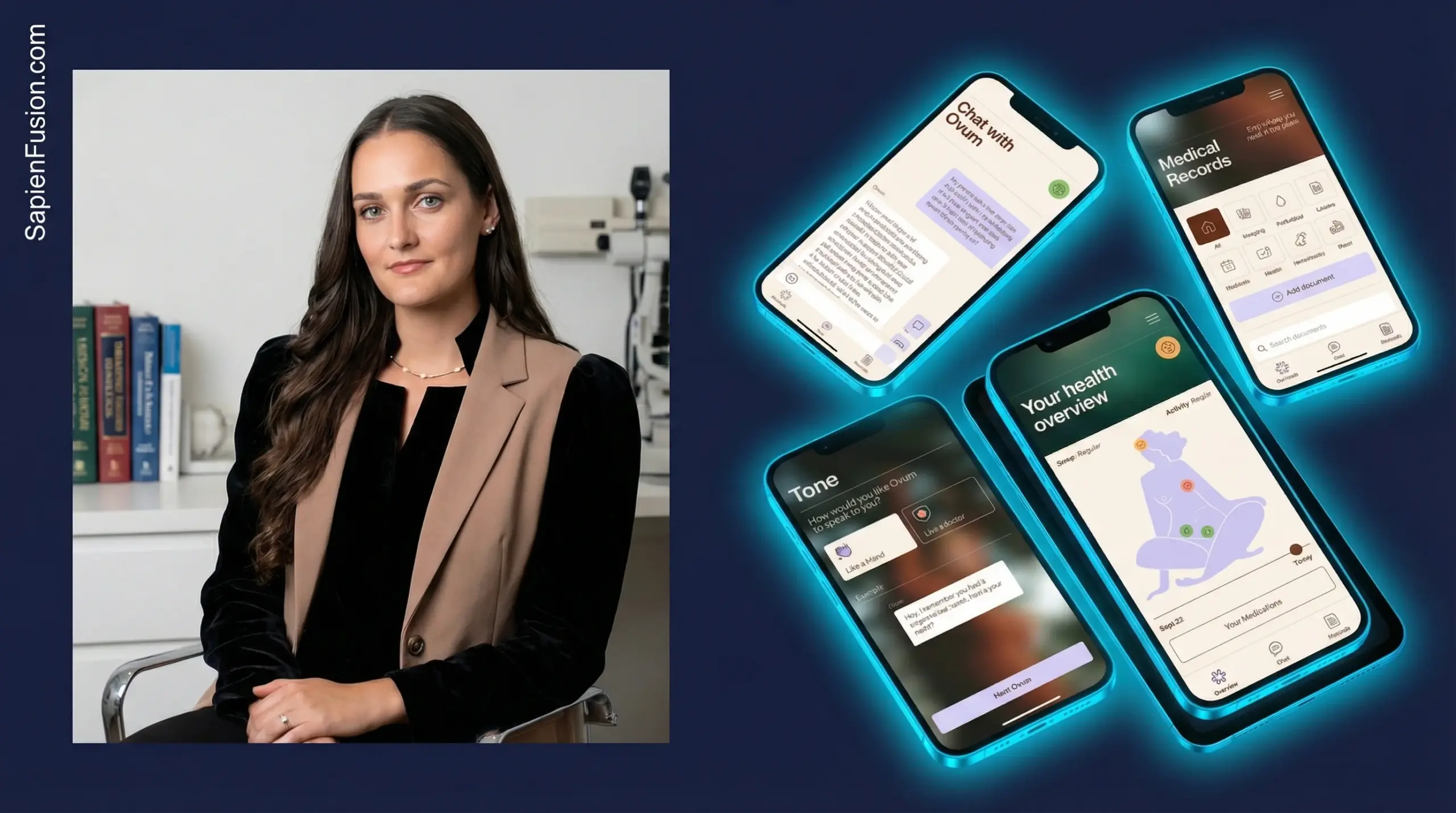
This is Part 2 of 7 from The Capital Efficiency Paradox Series.
← Part 1: Capital Efficiency Through Humanoid Telepresence | Part 3: $800M to Rebuild Drug Discovery →
[🧠] Sapien Fusion Deep Dive | February 16, 2026
Dr. Ariella Heffernan-Marks’ $1.7M Research Infrastructure Play
Third year of medical school. Chronic migraines so debilitating she could barely function. Despite understanding medical terminology, recognizing something was genuinely wrong, and knowing how to navigate the healthcare system, Dr. Ariella Heffernan-Marks was told: “It’s just anxiety.”
That dismissal—experienced by someone inside the medical system—crystallized what would become Ovum: an AI-powered health platform that’s simultaneously a consumer product for individual women and research infrastructure addressing the trillion-dollar gender health gap.
With $1.7 million in pre-seed funding, Ovum is building what doesn’t exist: the first longitudinal AI women’s health dataset while generating revenue from day one through direct consumer subscriptions.
The Bleeding Edge Problem
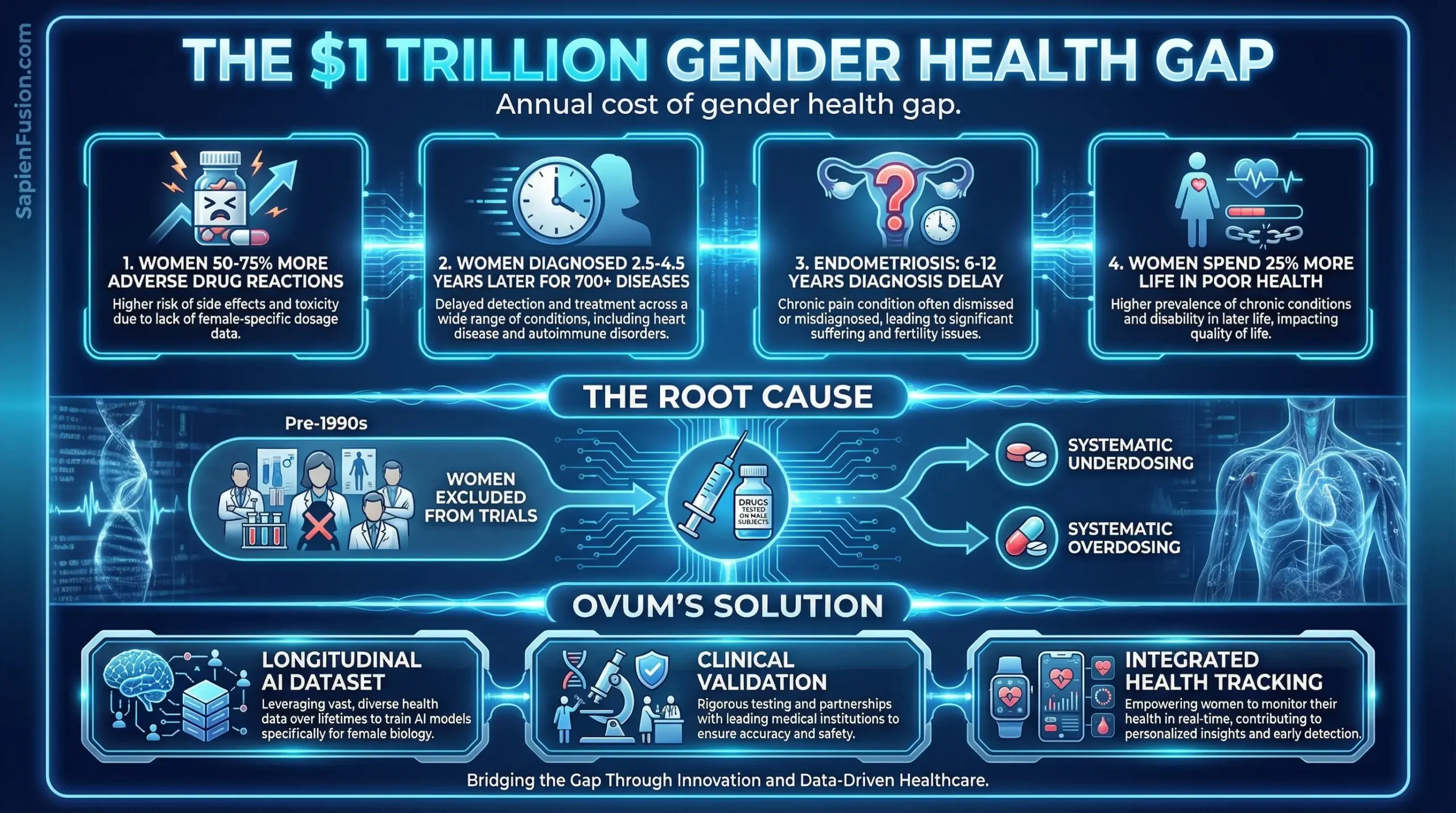
Before the 1990s, women of childbearing age were systematically excluded from clinical trials. The 1977 FDA guidance that formalized this exclusion created consequences that persist today: drugs developed and tested primarily on male subjects, leading to systematic underdosing, overdosing, and unforeseen side effects when women use them.
The numbers are brutal. Women are 50-75% more likely to experience adverse drug reactions. Women are diagnosed 2.5 to 4.5 years later than men for over 700 diseases. Endometriosis diagnosis averages 6-12 years of delay, while up to 70% of PCOS cases remain undiagnosed globally. Women spend 25% more of their lives in poor health than men.
This isn’t biological inevitability. It’s systemic research failure that costs the global economy $1 trillion annually.
Dr. Heffernan-Marks recognized that medical education itself perpetuates the problem. During her training at Macquarie University and internship at Prince of Wales Hospital in Sydney, she observed that curriculum taught women’s health as essentially limited to pregnancy, fertility, menopause, and complications—a remarkably narrow framing that erased the vast complexity of women’s health across the entire lifespan.
“Women’s health has been systematically siloed in medical training and clinical practice,” she explains. “Women see different doctors at different points in their lives and are treated at separate points rather than as integrated human beings with complex, cyclical physiology.”
The Dual-Infrastructure Thesis
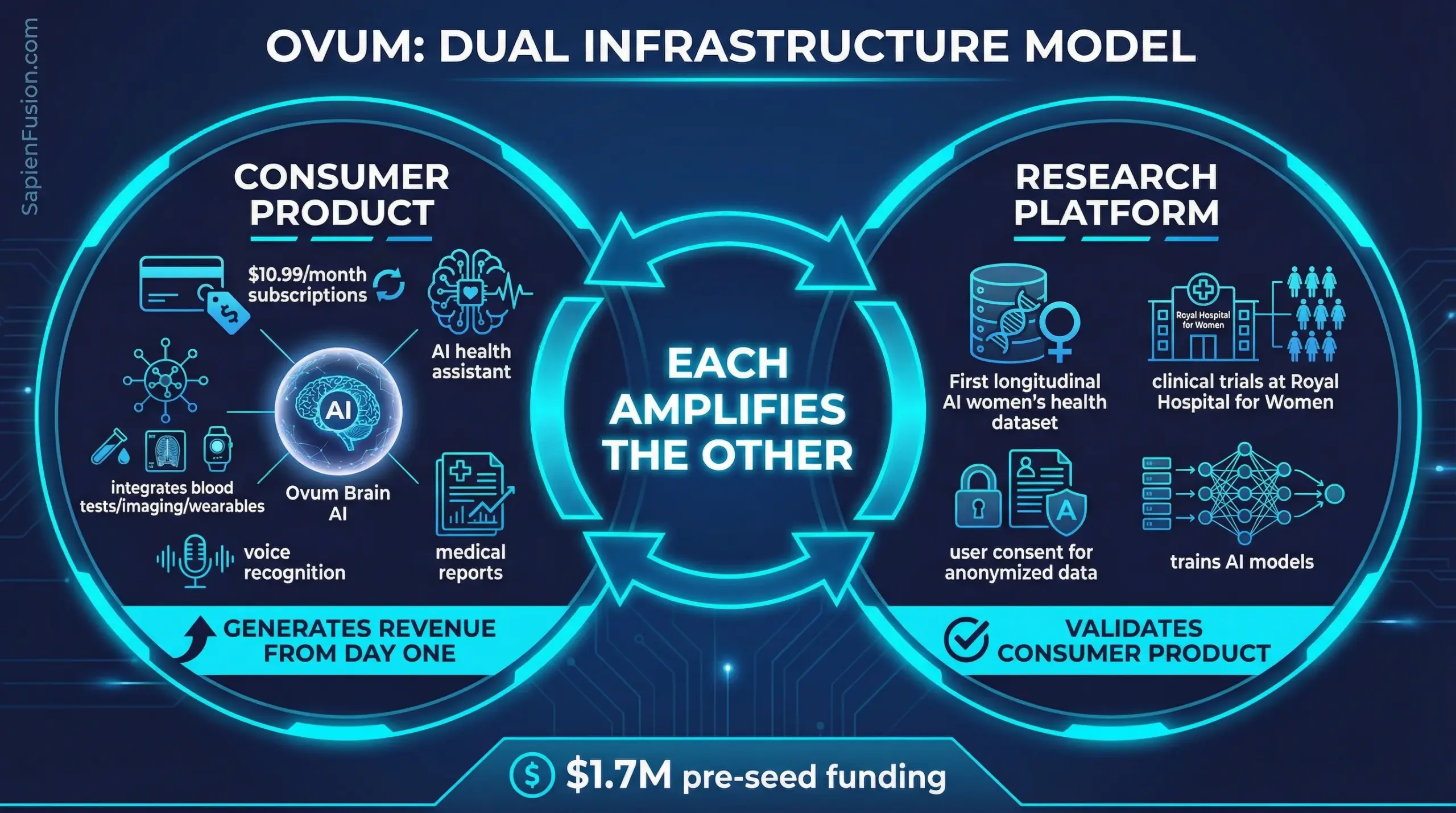
Here’s where Ovum’s capital efficiency crystallizes: instead of building either a consumer health app OR a research platform, Dr. Heffernan-Marks built both simultaneously, with each validating and funding the other.
On the consumer side, women pay $10.99 monthly or $94.99 annually for an AI health assistant that integrates blood test results, imaging reports, medical records, wearable data, and cycle tracking. The platform connects symptoms across time using voice recognition and conversational AI, generates medical reports women can share with healthcare providers, and learns individual health patterns through the “Ovum Brain” AI engine.
On the research side, with user consent, anonymized data contributes to the first-ever longitudinal AI women’s health dataset. This feeds clinical trials at Royal Hospital for Women and St George Hospital, generates evidence that will inform future medical practice, and trains AI models that address inherent biases in existing medical data.
This dual approach means Ovum isn’t burning capital waiting for research grants or enterprise sales cycles. Consumer revenue funds research infrastructure. Research validates consumer product. Each amplifies the other.
The Clinical Trial Validation
Most femtech companies launch products and only later—if ever—subject them to clinical validation. Dr. Heffernan-Marks inverted this: clinical trials launched in 2025 before broad public availability, with research designed to measure whether using Ovum actually increases women’s preventative health participation and sense of control.
Professor Amanda Henry, Head of The George Institute’s Women’s Health Program and Principal Coordinating Investigator, provides clinical supervision. Soul Patts pharmaceutical investment firm provided $40,000 specifically for clinical trial support.
This is capital-efficient positioning: validate through rigorous research while building revenue-generating consumer product, creating moats through both evidence base and user data.
The February 2022 Pattern Recognition
During her Prince of Wales Hospital internship, Dr. Heffernan-Marks witnessed something that would define Ovum’s strategic positioning: women were deeply fearful of the healthcare system, a fear stemming from experiences of dismissal, misdiagnosis, and having concerns minimized.
This fear was driving women toward social media for health information rather than consulting healthcare providers, creating dangerous feedback loops of misinformation among women who felt they couldn’t trust medical professionals.
The pattern she identified: women need AI not to replace doctors but to help them navigate doctors—to document symptoms systematically, recognize patterns across time, and communicate effectively in the limited time available during appointments.
“Ovum is about using new technologies such as AI to level the playing field,” Dr. Heffernan-Marks states. “Women endure complex and nuanced health conditions and they deserve a solution that directly addresses them.”
The Funding Architecture
Ovum raised $1.7 million in pre-seed funding from Giant Leap as lead investor, joined by Antler, Wollemi Capital, Nakatomi Venture Studio, and LaunchVic’s Alice Anderson Fund. Additional funding includes $250,000 from Morgan Stanley’s Inclusive Ventures Lab, $40,000 from Soul Patts for clinical trials, $20,000 from the LIFTwomen APAC grant, and recognition through the Enterprise, Big Data and AI award at SXSW Sydney 2024.
The investor thesis is explicit. Rachel Yang, partner at Giant Leap, explains: “Addressing women’s health represents not just a rapidly growing market projected to exceed $121 billion by 2033 but also a vital opportunity to tackle systemic gaps in women’s healthcare through innovation.”
Victoria Denholm, CEO of Wollemi Capital, adds: “Ariella is driven to make lasting change by disrupting a billion-dollar industry and improving health outcomes for Australian girls and women.”
What’s notable: investors recognized that the dual consumer/research model creates strategic moats. The longitudinal dataset Ovum is building has no equivalent globally. As it accumulates volume and diversity, it becomes foundational infrastructure for women-specific AI in healthcare.
The Team Composition:
Medical Credibility Meets Operational Precision
Ovum operates with 19 employees, lean but strategically assembled across leadership, medical advisory, and business advisory functions.
The leadership team brings complementary expertise. Dr. Ariella Heffernan-Marks serves as Founder and CEO, holding an MD from Macquarie with specialization in reproductive biology and embryology while pursuing her PhD at The George Institute. Madeleine Lucas serves as Chief of Staff and Operations, bringing a decade of experience at the intersection of business, investment, and culture. Stefanie Digianvincenzo leads marketing with creative leadership experience from Clemenger BBDO, DDB, AKQA London, and Meta.
The medical advisory board delivers world-class clinical credibility. Professor Michael Chapman brings expertise as a Fertility Specialist and Gynaecologist. Dr. Talat Uppal contributes gynecological expertise. Dr. Sue Haupt serves as Senior Research Fellow at the Centre for Sex & Gender Equity in Health. Dr. Manjri Raval provides endocrinology specialization.
The business advisory team adds operational depth and strategic guidance. Dr. Catherine Keating brings experience as former Medibank Senior Executive focused on Preventative Health. Emma MacKenzie contributes insights from her role as former Chief of Staff at Clue, the femtech company. Andy Timms and Benjamin Bray from Nakatomi Venture Studio provide founding partner perspective.
This composition demonstrates capital efficiency through expertise leverage: world-class medical and research advisors providing credibility and guidance without requiring massive headcount.
Strategic Implications
Ovum’s path illuminates a capital efficiency playbook that applies beyond healthcare.
The dual infrastructure model works when consumer product generates research asset. Consumer subscriptions fund longitudinal dataset creation while the dataset enables research that validates the consumer product. This creates compounding value that pure B2C or pure research models miss.
Clinical trial validation before scale, not after, creates moats through evidence and credibility. Rigorous upfront validation reduces customer acquisition costs and enables healthcare system integration later.
Targeting systemic problems where individual solutions and population solutions converge creates unique positioning. The gender health gap affects individual women and represents systemic research failure. Solving both simultaneously creates strategic positioning competitors can’t easily replicate.
Leveraging advisory expertise amplifies small teams. Nineteen employees backed by world-class medical, research, and business advisors delivers credibility and capability without 100-person headcount.
Revenue from day one reduces capital dependence. Consumer subscriptions at $10.99 monthly mean the company generates revenue immediately while building toward enterprise and healthcare system adoption.
The Data Sovereignty Positioning
Ovum’s approach to data privacy and user consent represents strategic differentiation. The platform operates under GDPR and SOC 2 standards, doesn’t require identifiable personal details allowing users to remain anonymous, never sells user data, and requires explicit opt-in for research participation.
The platform also offers a “pay it forward” model where women paying $21.99 monthly or $189.99 annually directly fund access for women facing financial barriers.
This isn’t corporate social responsibility decoration. It’s product architecture that builds trust, which drives adoption, which generates data, which creates the longitudinal dataset that represents Ovum’s long-term strategic asset.
Part of a Larger Pattern
Dr. Heffernan-Marks’ Ovum represents one expression of a broader phenomenon: women founders in healthcare AI are achieving disproportionate outcomes by building where systemic gaps create both urgent need and structural advantages for capital-efficient approaches.
The company launched on Apple App Store in August 2025 with a 4.7/5 star rating. Clinical trials at leading Australian hospitals are generating evidence. The longitudinal dataset is accumulating. Morgan Stanley’s Inclusive Ventures Lab is providing growth resources.
That’s not hypergrowth venture scaling. That’s methodical, validated, dual-infrastructure building that creates multiple paths to sustainable value creation.
The strategic window: healthcare AI models trained on existing medical data will reflect and amplify biases caused by the gender health data gap. First-mover advantage in women-specific longitudinal datasets represents foundational infrastructure positioning.
Dr. Heffernan-Marks is currently pursuing her PhD at The George Institute for Global Health, focused specifically on AI and women’s health. The academic positioning keeps the company grounded in rigorous research while building evidence base that will inform both medical practice and AI model development.
From dismissed medical student to founder building trillion-dollar gap infrastructure: that’s capital efficiency as strategic clarity about where systemic failure creates opportunity.
Learn More About Dr. Ariella Heffernan-Marks
Professional Profiles:
- LinkedIn – Connect professionally
- Ovum Team Page – Full bio and background
Current Position:
- Founder and CEO at Ovum
Recognition:
- Morgan Stanley Inclusive Ventures Lab ($250,000 funding, 2024)
- LIFTwomen APAC ($20,000 grant)
- Ovum AI won the Enterprise, Big Data and AI category on October 16, 2024.
Company Resources:
- Ovum App – AI-powered women’s health platform
- Download: iOS
- Clinical Trials – Royal Hospital for Women and St George Hospital
Research Focus:
- AI and Women’s Health – PhD research at The George Institute
- Clinical trials registered with ANZCTR and conducted at The Royal Hospital for Women and St George Hospital
- Longitudinal Health Datasets – First AI women’s health dataset
Media Coverage:
This is Part 1 of 7 from The Capital Efficiency Paradox
All parts in this series:
- Part 1: Capital Efficiency Through Humanoid Telepresence
- Part 2: Building the First Longitudinal Women’s Health Dataset
- Part 3: $800M to Rebuild Drug Discovery
- Part 4: $230M to $1B in Four Months
- Part 5: From 20 Researchers to 2.7 Billion Downloads
- Part 6: Capital Efficiency Through Government-to-Commercial Path
- Part 7: The Capital Efficiency Playbook
- Research Methodology and Source Verification for the Capitol Efficiency Paradox Series